Pros Use Checklists
July 2026
There’s a quiet assumption a lot of people carry into their careers: checklists are for beginners. Once you’re actually good at something, the thinking goes, you shouldn’t need one — real expertise means holding it all in your head. It’s a natural assumption, and it’s backwards. Look at who actually relies on checklists in the real world, and a different pattern shows up: the more consequential the work, the more likely you are to find a checklist behind it, used by people who are unquestionably experts.
Who actually uses them
Pilots run a checklist before, during, and after every single flight — airline captains with tens of thousands of hours, and fighter pilots flying some of the most demanding aircraft built, alike. Not because they don’t know the steps — because the list of things that can go wrong exceeds what any human working memory can reliably hold under pressure, every time, with zero acceptable failure rate. Fighter pilots are arguably the sharpest edge of this: among the most rigorously selected and drilled people in any profession, and they still run the checklist every time — which is exactly what makes it so notable on the rare occasion one doesn’t, as the HUD tape further down shows. The checklist doesn’t replace the pilot’s skill; it protects that skill from a bad day, a distraction, an interruption mid-sequence.
And it’s run through the emergency, not after it. U.S. Navy flight-training doctrine (Naval Air Training Command, VT-6 primary flight training squadron) teaches three rules for any airborne emergency, in order: maintain aircraft control, analyze the situation, then take the appropriate action — and that third step is the checklist itself, executed from memory if it has to be, second only to flying the jet and ahead of even landing. The FAA teaches civilian pilots the same order (FAA Safety Briefing, General Aviation Joint Steering Committee): aviate first, always — but the checklist isn’t something that waits for calm air to run.
Surgeons are the case that changed a lot of minds on this, thanks largely to Atul Gawande’s book The Checklist Manifesto (affiliate link). Gawande, a practicing surgeon, documented how a short, deliberately simple pre-surgical checklist — confirm the patient, confirm the site, confirm the antibiotics, confirm the team knows each other’s names and roles — measurably reduced real surgical complications when it was actually followed. Separately, the central-line-infection checklist work led by Dr. Peter Pronovost at Johns Hopkins is one of the most cited examples in patient-safety literature of a simple checklist catching exactly the kind of well-known, individually-obvious step that still gets skipped under real-world time pressure. In both cases, the people using the checklist were highly trained specialists — the checklist wasn’t compensating for a lack of skill, it was compensating for the truth that skill alone doesn’t protect against distraction, fatigue, and complexity.
Engineers and manufacturing teams run the same discipline under different names: control plans, PFMEAs (Process Failure Mode and Effects Analysis), standard work instructions, quality gates. A control plan is, functionally, a checklist — a deliberate, written record of what must be checked, in what order, and why, so that the process doesn’t depend on one person’s memory on one particular day. In my own manufacturing engineering career, the projects that ran cleanly were never the ones where someone especially talented held it all in their head. They were the ones where the critical steps were written down, verified, and followed the same way every time — by the newest tech on the line and the most senior engineer alike.
When the checklist gets skipped
On 9 November 1995, an F-15A callsign “Misty One” suffered a right engine fire on final approach into Whiteman AFB. The checklist was simple and unambiguous: if the fire continues after shutdown, eject. The pilot shut the engine down — but the fire continued — and instead of following it, he elected to press a high-speed landing to try to save the jet. He overran the runway and ejected as the aircraft went off the departure end. The F-15 was destroyed. He walked away.
That’s not a story about a bad pilot — it was a highly trained professional making a human decision under real pressure, exactly the moment a checklist exists to protect against. Here’s C.W. Lemoine’s full HUD tape analysis; worth watching it play out in real time:
What makes a checklist actually work
The common thread across aviation, surgery, and manufacturing isn’t “these fields are dangerous.” It’s that complexity has genuinely outgrown what any individual’s memory and judgment can reliably manage alone, every time, under real conditions. A checklist isn’t an admission you don’t know your job — it’s a tool competent people use because they understand how failure actually happens: not from not knowing the step, but from skipping a known one under pressure. Gawande’s own research backs this up here too: a bad checklist is worse than no checklist, since it trains people to stop trusting the list. A few rules that hold up across every domain above:
- Short, not exhaustive — only the steps that are easy to forget under pressure, not a full training manual.
- Built by the people doing the work, not imposed on them.
- A verification step, not just an instruction — said out loud, marked, or confirmed by a second person.
- Revised when it fails, not defended.
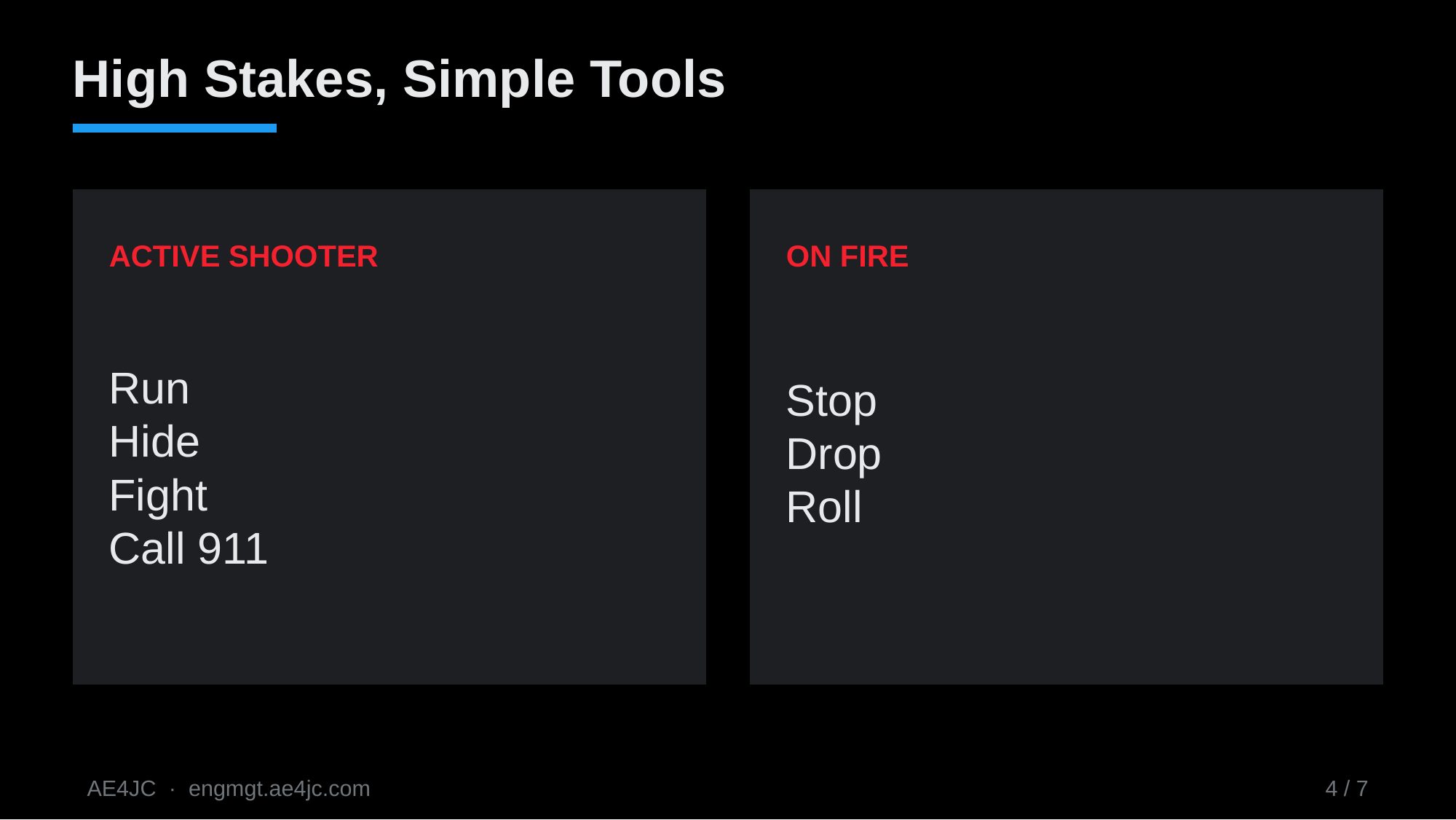
None of this is limited to cockpits and operating rooms, either — you already carry checklists like this without labeling them as such. Active shooter: Run, Hide, Fight, Call 911. On fire: Stop, Drop, Roll. Same design pattern, built for a general audience instead of a trained specialist.
The takeaway
If your team’s critical processes live only in the head of your most experienced person, that’s not a sign of strength — it’s a real, unaddressed risk, no matter how good that person is. The fix is the same discipline Gawande, Pronovost, and every airline captain and fighter pilot — the C.W. Lemoines of the world — already rely on: a short, verification-based checklist for the steps that are easy to know and easy to miss, built by the people doing the work, and revised the first time it actually fails.
That’s not a beginner’s tool. It’s what high performers actually use.
Want the short version to share or print? Download the one-page “Pros Use Checklists” PDF summary.